Info
L’article est disponible en français ! 🇫🇷
Who would have thought that sardine speculation had a future? Not the aficionados of the Sardine Game in any case! These dedicated members of the French forum 18-25 aim to cure sardines themselves by storing cans of sardines in their cupboards for potentially years. By allowing the oil to gently permeate every cell of the fish, they hope to perfect the taste and texture of their favorite food.
But in January 2026, their world collapses as their vintage sardines turn into gold bars! The culprit? The staggering rise in fish prices, combined with an unprecedented loss of quality.
 « I just noticed that a few weeks ago there was a big shortage of sardines on the shelves, and I heard that the fishing was disastrous, especially for finding ones of a suitable size. So I imagine they’ve been forced to be less selective? »
This decline in sardine numbers can be attributed to several successive factors. First, climate change is having an impact on the zooplankton that sardines feed on. Small copepods have grown in size, while larger ones have shrunk. As a result, sardines must work harder to feed in a warmer, more acidic, and less oxygenated ocean. The best that can be hoped for is a stabilization in the size and weight of marine organisms. Damn!
Added to this is a problem well known to lovers of Atlantic cod: overfishing. Sardine stocks in the Bay of Biscay have collapsed, with biomass falling by almost three-quarters in 20 years. Anchovies have followed a similar path. Without fishing restrictions, there will be no long-awaited renewal of stocks! Much to the chagrin of fishermen, who are becoming fewer and fewer each year as the generational turnover breaks down: “Young people are turning away from this profession because it is not viable,” laments Yvan Le Lay, president of the association of Breton fishermen. A fate that is unfortunately typical of the tragedy of the commons.
What solution for our French canneries? Import from Portugal, Spain, and Morocco! But these countries are beginning to experience the same difficulties as France. Alarm bells are ringing in Morocco with a ban on frozen sardine exports as of February 1! Sardine catches there have fallen from 965,000 tons in 2022 to 525,000 tons in 2024. A dramatic 46% drop in two years has prompted the kingdom to cut off the EU’s main source of sardine supply. Small pelagic fish account for nearly 80% of the country’s fish stocks and are normally exported in large quantities. Galicians are complaining, while the Russians still have authorization to fish extensively in Moroccan waters. Not to mention that Moroccan trawlers discard up to 43.7% of their catch! This hypocrisy benefits neither the sardine nor the European economy. Portugal, for its part, is less grandiose about its export restrictions.
We might hope for at least a stabilization in the supply of canned sardines. But no! The European canning cartel intends to dig deep into its pockets to supply delicatessens with quality sardines! The brand image of French, Portuguese, or Spanish sardines is a plus for winning over consumers. The fact is that this little blue fish is rich in omega-3, vitamins, minerals, and protein! So many qualities highlighted by an industry that only anticipates profits for the current quarter. Sardines are eating into sales of canned tuna and mackerel, which suffer from a disastrous image due to the increase in methylmercury concentration in the fatty parts of these fish (due to increasing human pollution).
In an industry without automated production methods, smaller sardines mean higher labor costs. Costs are said to have skyrocketed by 30 to 40% in Spain and Portugal. As a result, the sardine market is undergoing a transition that will appeal to the bourgeois bohemians. La Belle-Îloise continues to export at a steady rate, accounting for 10% of its turnover in luxury American stores! And sources of profit are never far away for salespeople, who can count on a 12% increase in value in organic stores. And canneries are rushing to fill the gap in “100% natural” sardines (whatever that means exactly). This is heresy when we know that organic products offer only negligible benefits, whether nutritionally or ecologically. The only winner is the producer. Consumers will see part of the production go to a market that is often inaccessible to their wallets. The popular shelves are emptying and sardines are becoming a luxury! I won’t list all the canneries jumping on the organic bandwagon, because almost all of them are jumping on the trend, and I would ask everyone to mentally prepare themselves for the indecent prices being charged.
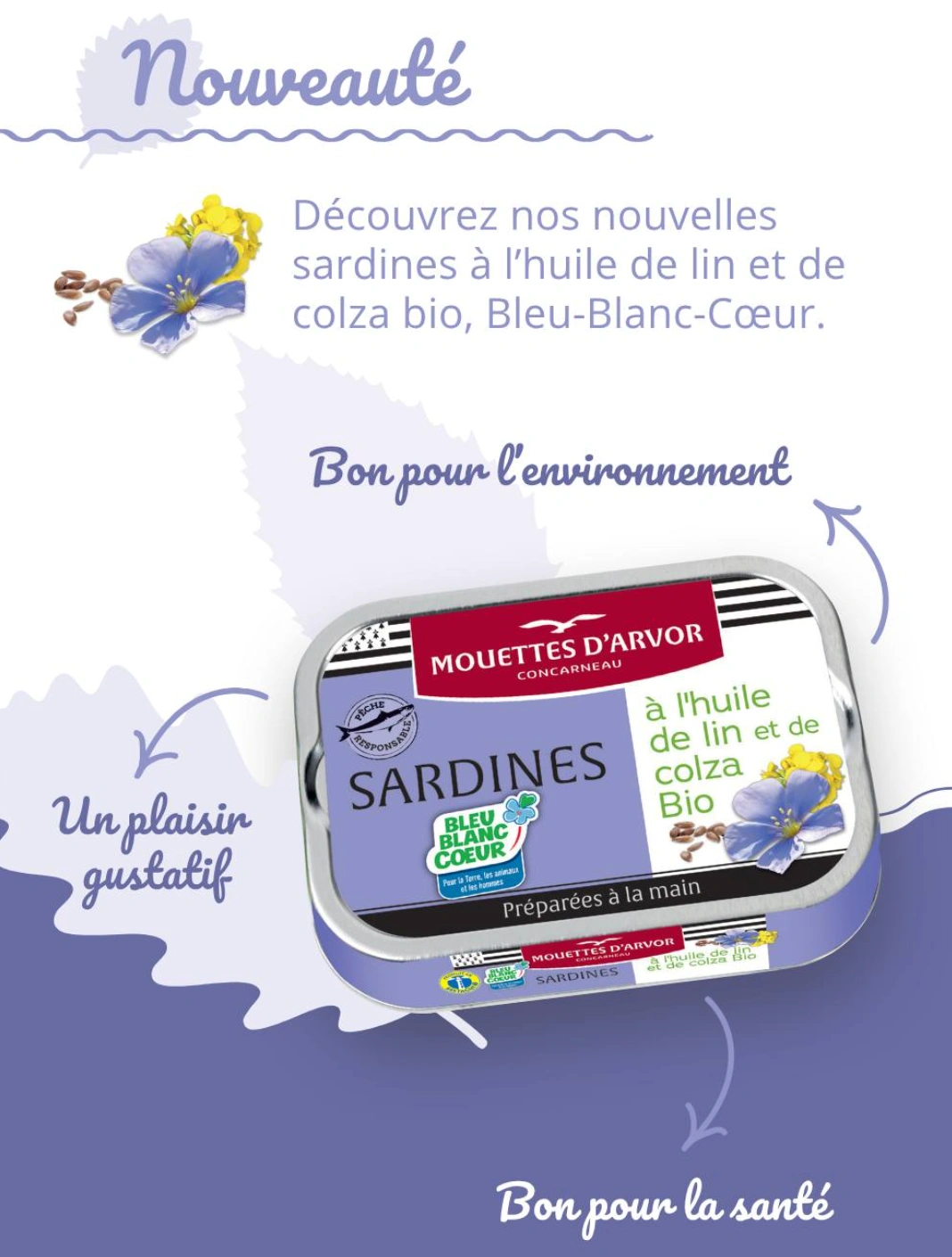 The beginning of the end for your wallet, courtesy of Mouettes d’Arvor
Another solution for increasing prices while deceiving buyers? The explosion of misleading or even esoteric certifications such as “Responsible Fishing” or “Label Rouge.” The latter can now certify 4 to 7 (mini) sardines per can, compared to 4 to 6 previously.
Sardine lovers have already noticed the gradual decline in quality of this culinary treasure; soon, the rest of Europe will too, with the decline of an entire industry blinded by capitalism.